Integrative Pain Management for Avascular Necrosis | Acupuncture & Ayurveda

Every time I sit down with an orthopedic surgeon, I always have one question ready: "Why the femoral head? What makes the head and neck of our largest weight-bearing bone so much more susceptible to necrosis than any other bone in the body?"
He smiles and offers an analogy about an elephant and its tusks. He explains that wild
elephants frequently suffer tusk injuries and fractures because they fight.
"But humans aren't fighting in the wild," I interrupt.
He smiles again and says, "Of course we are fighting. We're fighting alcohol addiction, steroid abuse, post-COVID complications, and so much more."
The history of avascular necrosis features two distinct surges, an initial rise in the late 20th
century (Nixon, 1983), followed by a second major spike in the wake of the COVID-19 pandemic (Sakellariou et al., 2023). The post-COVID-19 surge has marked a distressing clinical trend characterized by an accelerated disease onset (Sakellariou et al., 2023). Witnessing a rapidly growing cohort of young patients progress to total hip arthroplasty within a remarkably short timeframe presents a significant challenge to conservative joint preservation (Annapareddy et al., 2025). It is widely recognized that the combination of COVID-19-induced endothelial inflammation and steroid therapy acted synergistically, sparking a dramatic spike in Avascular Necrosis among young adults in the post-pandemic era.(Annapareddy et al., 2025)
Now coming back to the question "Why head of femur" ?
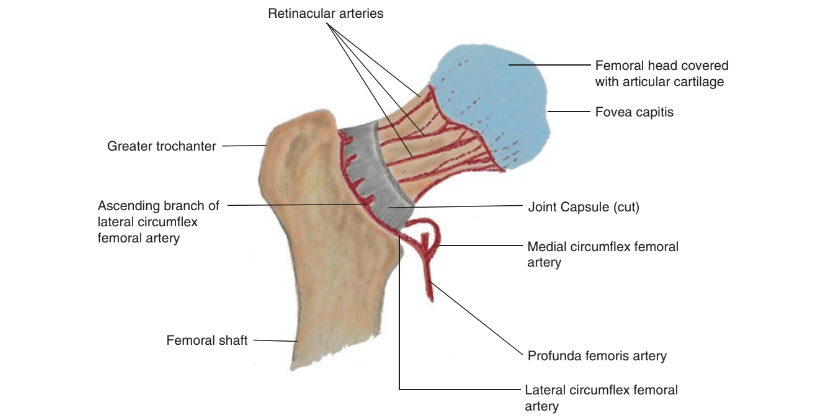
Complex Joint Articulation and Sensitive Blood Supply: The hip's intricate ball and socket structure relies on a precise articulation between the acetabulum and the cartilage-covered femoral head. This high load joint depends on a delicate and highly vulnerable vascular network. Arising from the profunda femoris, the medial and lateral circumflex femoral arteries form an arterial ring around the femoral neck. From here, fine, terminal retinacular arteries traverse the joint capsule to supply nourishment to the subchondral bone. Because these end-arteries lack collateral back-up paths, any increase in intra-capsular pressure or microvascular injury can easily sever blood supply, making the femoral head uniquely susceptible to ischemic necrosis. (Kumar et al., 2023)
Managing AVN Pain: The Role of Acupuncture and Ayurveda
In the early, pre-collapse stages (Steinberg Stages 0, 1, and 2), the femoral head retains its
natural round shape despite underlying blood flow restriction or early tissue changes. This
represents the primary window for conservative care, where the goal is to promote microvascular flow, soothe inflammation, and support bone health before physical collapse
occurs.(Steinberg et al., 1984)
The Critical Threshold (Steinberg Stage 3) When a subchondral fracture appears (the
"crescent sign"), the joint reaches a critical turning point. Although the bone head has not yet
flattened, its structural integrity is weakened. Conservative strategies at this point focus strictly on supportive pain management and reducing joint pressure, but must be carefully managed alongside strict non-weight-bearing protocols.(Steinberg et al., 1984)(Steinberg et al., 1995)
When Surgical Evaluation Is Necessary (Steinberg Stages 4–6) Once the condition
progresses to Stage 4 and beyond, the femoral head flattens, joint space narrows, and joint
cartilage breaks down.(Steinberg et al., 1995) At these advanced stages, non-surgical
approaches shift entirely to supportive pain and mobility care. Conservative therapies cannot
rebuild collapsed bone architecture or reverse cartilage loss, making orthopedic surgical
evaluation necessary.

Crescent sign (Kumar et al., 2023)
With the ideal therapeutic window established focusing conservative care strictly on Steinberg Stages 0, 1, and 2 prior to structural collapse we can now examine how Acupuncture and Ayurveda assist in managing AVN-related pain.
Acupuncture
Jin et al. (2021) demonstrated that integrating acupuncture and moxibustion into conventional treatment protocols yields significantly superior outcomes for patients with early- and middle- stage femoral head osteonecrosis compared to standard care alone. Across a meta-analysis of nine randomized controlled trials involving 630 subjects, the combination therapy achieved statistically significant increases in overall clinical efficacy, "excellent and good" response rates, and post-treatment Harris Hip Scores (HHS). Beyond improving functional mobility and joint recovery, the inclusion of acupuncture also enhanced patient safety, leading to a significant reduction in treatment-related adverse reactions compared to conventional intervention alone.
While clinical trials confirm that integrating acupuncture with conventional care significantly
improves functional mobility and chronic pain management in AVN, a critical biological question remains: Can acupuncture or traditional Chinese medicine (TCM) modalities exert a direct, measurable impact on microvascular endothelial cells within the necrotic bone?
We do not have a direct answer for this since it lacks large sample studies. Much of our
understanding of acupuncture's capacity to modulate endothelial health relies on preclinical models or protocols in related microvascular fields. For instance, Wen et al. (2025) highlighted the fundamental role of endothelial dysfunction in microvascular impairment, emphasizing how electroacupuncture targets key endothelial biomarkers like nitric oxide and endothelin-1 to restore microvascular vasomotor tone and tissue perfusion. While their trial protocols focus on systemic and cerebral microcirculation, the underlying biological mechanism using micro-stimulation to regulate endothelial-derived vasodilators and relieve vascular resistance provides a strong theoretical parallel for bone microvasculature. Expanding on this foundation, a 26-year bibliometric analysis by Wang et al. (2024) confirmed that modulating endothelial cells, vasoactive substances, and signaling pathways (such as VEGF/eNOS pathways and endothelial progenitor cells) represents a primary global research hotspot in acupuncture-mediated microcirculation.
Ayurveda
Ayurveda has produced numerous case reports featuring before-and-after radiological evidence following comprehensive Panchakarma procedures. Let's explore them one by one.
An illustrative example of documented radiological regression following Ayurvedic intervention is detailed by Singh et al. (2023) in the Journal of Ayurveda and Integrative Medicine. The case report evaluated a 48-year-old male with severe bilateral hip pain whose baseline MRI confirmed advanced bilateral Avascular Necrosis, staged as Steinberg Grade III-B in the left hip and Grade IV-A in the right hip. The patient underwent an integrative Ayurvedic protocol comprising 24 days of intensive Panchakarma specifically medicated enemas and Swedana (medicated rice-bolus sudation) alongside a 30-month regimen of oral Rasayana formulations. Remarkably, a follow-up MRI at 23 months revealed clear structural down-staging in both joints: the left hip regressed from Grade III-B down to Grade II, while the right hip regressed from Grade IV-A down to Grade III. Beyond the objective radiological regression, the patient achieved complete pain relief during normal daily activities and demonstrated significant gains in hip range of motion, highlighting the potential of targeted Panchakarma and Rasayana protocols to arrest subchondral collapse and support tissue remodeling.
In a detailed 2026 case report published in the International Journal of Ayurvedic Medicine,
Paliwal et al. documented significant functional recovery and radiological down-staging in a 32 year old male suffering from bilateral corticosteroid-induced femoral head Avascular Necrosis following COVID-19 treatment. At baseline, the patient was wheelchair-dependent with severe pain (VAS 10/10 on the right, 9/10 on the left) and marked mobility restrictions. His initial MRI revealed secondary AVN staged as Arlet & Ficat Stage III, Mitchell Class D in the right hip (with 50% articular involvement, cortical bony collapse, and moderate effusion) and Stage II, Mitchell Class A in the left hip. After declining recommended bilateral total hip arthroplasty, the patient underwent a 6-month, multimodal Ayurvedic protocol delivered in three 60-day cycles. The regimen combined repeated Basti therapies and local Snehana-Swedana alongside targeted oral formulations Follow-up MRI at six months demonstrated clear structural improvement, showing bilateral down-staging to Stage II, Mitchell Class B, with total articular surface involvement reduced from 50–60% down to 15–30% bilaterally and no evidence of subchondral collapse. Clinically, the patient transitioned from wheelchair reliance to independent walking, stair climbing, and squatting, with VAS pain scores dropping to 5/10 on the right and 2/10 on the left.
In a 2020 case study published in the International Journal of Health Sciences and Research, Kabra et al. evaluated the non-surgical Ayurvedic management of a 46-year-old male suffering from bilateral Avascular Necrosis (AVN) of the femoral head complicated by Grade 2 Osteoarthritis on the right side and Grade 2 AVN on the left. The patient presented with a two year history of debilitating hip and lower back pain, night pain, and an antalgic limping gait caused by a 1 cm shortening of the right leg. Facing total hip replacement advice, he elected to undergo a structured inpatient Ayurvedic protocol that integrated sequential Panchakarma procedures. Following treatment, the patient achieved marked clinical improvements: his Visual Analogue Scale (VAS) pain scores dropped from 7/10 to 3/10 in the right leg and 6/10 to 3/10 in the left leg, while hip flexion improved significantly from 66 degree to 82 (right) and 110 degree to 125 (left). Most notably, his Oxford Hip Score rose from 17 (indicating severe arthritis/surgical candidacy) up to 36 (indicating mild-to-moderate involvement manageable conservatively), demonstrating the potential tissue-nourishing Ayurvedic protocols to arrest progression and restore joint mobility without immediate surgical intervention.
Agrawal et al. 2012 evaluated the clinical efficacy of an Ayurvedic regimen in 10 patients with
early-stage femoral head Avascular Necrosis (under Grade III). The study focused on assessing subjective symptom relief following a 1-month protocol combining daily Panchatikta Ksheera Basti with oral Abha Guggulu Across the 30-day intervention, the cohort demonstrated a 58.33% reduction in hip pain and a 50% reduction in hip stiffness yielding a 54.17% overall clinical improvement. The authors concluded that this protocol serves as an effective conservative measure to relieve symptoms and help arrest early disease progression in the hip joint.
Limitations
A major limitation of the current literature on Ayurvedic management of Avascular Necrosis
(AVN) is its heavy reliance on single-patient case studies and very small cohorts, with the
largest published trial reaching a sample size of only N=10.
To truly evaluate the clinical viability of these non-surgical protocols, we urgently need large-
sample, multi-center prospective studies that utilize standardized treatment regimens. Robust trials are essential not only to validate clinical efficacy and radiological recovery beyond isolated instances, but also to rigorously assess whether patients across different age groups and body constitutions can safely tolerate and sustain intensive, multi-modal therapies over time.
Conclusion
Human life is an intricate series of profound challenges interspersed with fleeting moments of joy and facing a diagnosis of Avascular Necrosis is undoubtedly one of those formidable trials. The femoral head, acting as the structural tusk of human mobility, demands timely conventional intervention to preserve the natural joint and delay or prevent total hip replacement. Yet, when evidence based, holistic approaches can be combined with standard care to enhance outcomes, there is every reason to embrace them. The true clinical art lies in knowing when to intervene, accurately mapping the exact stage of structural compromise, and applying targeted therapies that meaningfully restore a patient's quality of life.
While Total Hip Arthroplasty remains the standard surgical intervention for advanced articular
collapse, the pre-collapse stage (Steinberg Stages 0–2) represents an important window for
studying non-surgical joint preservation strategies. Preclinical research suggests acupuncture may influence microvascular endothelial function and assist in chronic pain management, while preliminary observational data on structured Ayurvedic Panchakarma and Rasayana protocols suggest potential effects on subchondral tissue stability.
Moving forward, evaluating the role of these integrative modalities within mainstream
orthopedics requires greater scientific rigor. Transitioning from isolated case reports to large-
sample, multi-center prospective trials will be essential to evaluate standardized protocols
across diverse patient demographics and age groups. By combining precise radiological staging with rigorous, patient-centered research, future studies can help clarify the place of supportive integrative care in long-term joint health management.
References
Nixon J. E. (1983). Avascular necrosis of bone: a review. Journal of the Royal Society of
Medicine, 76(8), 681–692. https://doi.org/10.1177/014107688307600810
Sakellariou, E., Argyropoulou, E., Karampinas, P., Galanis, A., Varsamos, I., Giannatos, V., Vasiliadis, E., Kaspiris, A., Vlamis, J., & Pneumaticos, S. (2024). A Comprehensive Review of COVID-19-Infection- and Steroid-Treatment-Associated Bone Avascular Necrosis: A Multi-Study Analysis. Diagnostics (Basel, Switzerland), 14(3), 247. https://doi.org/10.3390/diagnostics14030247
Annapareddy, A., Mulpur, P., Jayakumar, T., Boddeda, S., Mahajan, A., Prasad, V. B. N., & Reddy, A. V. G. (2025). Outcomes of Hip Avascular Necrosis Following COVID-19 Infection: A Retrospective Analysis of 212 Hips With Minimum Two-Year Follow-Up. Cureus, 17(7), e87230. https://doi.org/10.7759/cureus.87230
Kumar, P., Aggarwal, S., & Vishal. (Eds.). (2023). Insights into avascular necrosis of the femoral head. Springer Singapore. https://doi.org/10.1007/978-981-99-1346-6
Steinberg, M. E., Hayken, G. D., & Steinberg, D. R. (1984). A new method for evaluation and staging of avascular necrosis of the femoral head. In J. Arlet, R. P. Ficat, & D. S. Hungerford (Eds.), Bone circulation (pp. 398–403). Williams & Wilkins.
Steinberg ME, Hayken GD, Steinberg DR. A quantitative system for staging avascular necrosis. J Bone Joint Surg Br. 1995;77:34–41
Jin, H., Li, L., Yu, W., & Fu, Y. (2021). The efficacy of acupuncture and moxibustion for early and middle-stage osteonecrosis of the femoral head: A systematic review and meta-analysis of randomized controlled trials. Medicine, 100(22), e26210. https://doi.org/10.1097/MD.0000000000026210
Wen, J., Dong, X., Chen, X., Luo, X., Wang, Y., Gong, Y., Ma, K., Zhong, D., Yan, Q., Li, J., & Zhang, L. (2025). The Effect of Electroacupuncture on Microcirculation in Patients With Hypertension and Cognitive Impairment: Protocol for a Multicenter Randomized Controlled Trial. JMIR research protocols, 14, e70876. https://doi.org/10.2196/70876
Wang, Q., Zhang, Q., Lu, F., Hu, H., & Zhu, M. (2024). Trends in Acupuncture Therapy for Microcirculation and Hemorheology from 1998 to 2023: A Bibliometric and Visualized Study. Journal of Pain Research, 17, 177–196. https://doi.org/10.2147/JPR.S441512
Singh, S. K., Rajoria, K., & Sharma, S. (2023). An Ayurveda approach in the management of avascular necrosis of bilateral hip joint-A case report. Journal of Ayurveda and Integrative Medicine, 14(5), 100792. https://doi.org/10.1016/j.jaim.2023.100792
Paliwal, A. A., Asutkar, V. G., Rasane, S. R., Pansare, S. G., Babar, S. C., & Jadhav, M. P. (2026). Functional recovery and radiological down-staging through Ayurveda management in bilateral corticosteroid-induced femoral head avascular necrosis: A case report. International Journal of Ayurvedic Medicine, 17(2), 580–585. https://doi.org/10.47552/ijam.v17i2.6682
Chauhan, A. S. (2026). Complete recovery of avascular necrosis (AVN) with Ayurveda without surgery: A case study. International Journal of Drug Delivery Technology, 16(5s), 201–212. https://doi.org/10.25258/ijddt.16.5s.24
Kabra, D., Jena, S., Bhatted, S. K., & Dharmarajan, P. (2020). Avascular necrosis of femoral head-Ayurveda management: A case study. International Journal of Health Sciences and Research, 10(11), 22–27.
Agrawal, R. R., Patange, A. K., & Sharma, B. G. (2012). A clinical study on role of panchatiktaksheerbasti and aabha guggula in the management of avascular necrosis of hip joint. Ancient Science of Life, 32
Disclaimer: For Educational Purposes Only. This information is not intended as medical advice, diagnosis, or treatment. Always consult with a qualified healthcare professional for any health concerns or before making any decisions related to your health or treatment.


